
November 22, 2026
“We become a dwelling place of the divine.” The Kabbalah
For those unfamiliar with Advent, it is a season in the Christian Church that focuses on stillness, patience, waiting, expectation, hope, and joy in the four weeks that lead up to Christmas Eve. Not all, but many, denominations offer Advent practices. In the darkest, often loneliest, time of the year, Advent holds up a candle that shines in the night, a candle that leads the way to Love.
For those unfamiliar with monks, picture the religious brown-hooded and robed sandal-footed man living with his brothers in silence and service or the shorn-headed Asian contemplatives wearing their orange, sarong-like wraps and praying for peace. The great Trappist priest, monk, mystic, and spiritual author, Thomas Merton, wrote that “Monks are people who seek to devote all their time to knowing God better and loving Him more.”
Christine Valters Paintner, Abbess of “The Abbey of the Arts,” defines a monk not only as someone living in a monastery, but as a universal archetype and an “inner monk” present in everyone—characterized by single-heartedness, contemplative presence, and a longing to seek the sacred in everyday life. Whether we wear brown robes, orange wraps, or blue jeans; whether we live in a monastery, convent, with family or by ourselves in a fourth floor apartment, we each have been invited to meet and honor our own inner monk.
But that invitation requires intention. Sandwiched between Thanksgiving and Christmas in the United States, Advent is often the busiest time of year whether we count ourselves spiritual or not. To watch for the light, to wait for it, to encounter it, to keep it aflame often feels countercultural. Practicing Advent calls on a part of our souls, our spiritual nature, that many name the “inner monk.”* Scores of books, podcasts, classes, and programs have been centered on the inner monk and how to integrate that essential part of our Selves into our daily existence where everything is spiritual, mystical, mysterious. We just don’t see it. Yes, monks like to be alone, but not shut away in their cells, doors bolted, never to be engaged! When we forget our inner monk, we exist more than live because engaging our inner monk is really about engaging our hearts.
Since the tradition of Advent calls for slowing down and paying attention, it seems a special time to greet and cultivate our own inner, Advent, monks, which is what I will be offering in this blog space. We’ll be calling not only on Christian tradition but also on the wisdom of spiritual traditions across the globe because what we are seeking is God—not the God we keep safely contained in a box of our own making, not the God of our Sunday School classes, or the God we cast off long ago— but the God that goes by so many names and yet cannot be named: Universal, the Higher Power, Abba, Allah, Mother, Nature, Yahweh, Father, Divine Love, I AM.
Each week of Advent, I’ll present an opportunity to grow in relationship with our inner monk. These invitations will include (1) creating a sacred space, a monastery of sorts, for our monk; (2) exploring the gift of time; (3) seeking community because monks need and want company; and (4) encountering mystery. Expect some poetry along the way. Just as monks in the ancient church carved out real spaces in the hills in which to invite God into their hearts, we’ll be carving out a place in our own lives, perhaps even in our hearts, making space for God-with-Us.
Blogs will be posted on Sundays and Wednesdays during Advent, beginning November 29, with a poem on Nov. 25th to get us started.
I hope you will join me.
Rosemary
*Some of my guides in discovering my own inner monk are the Franciscan priest and contemplative, Richard Rohr; the poets Mary Oliver and Wendell Berry; the abbess of The Abbey of the Arts, Christine Valters Paintner; the grace-filled women in the artist/monk group with whom I journeyed for six years; the resources from the website Grateful Living, and many mystics over the ages, including the psalm writer, David, Jesus Christ, St. John of the Cross, Julian of Norwich, C. S. Lewis, and the Islam poet, Rumi.
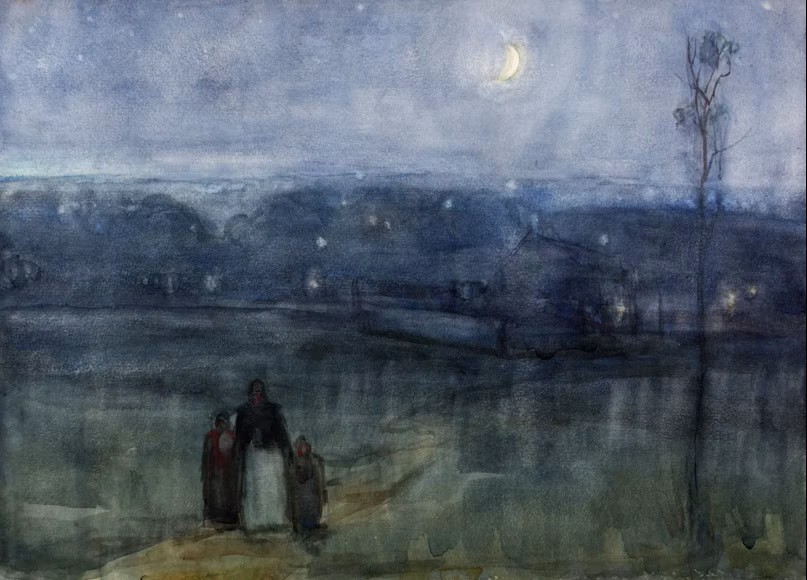
Photo credit: Henry Ossawa Tanner, Kansas City, Kansas, 1897, Smithsonian American Art Museum/courtesy of Unsplash


Looking forward to it! Thank you!
LikeLike
Thank you Rosemary. I look forward to it. Jocelyn.
LikeLike
Great!
LikeLike